




SERVICES
Dentist in Tracy, CA
What a Routine Dental Exam Really Checks
A routine dental exam checks more than your teeth for cavities. Your dentist also looks at your gums, jaw, bite, and the soft tissue in your mouth. Many of these problems don’t hurt early on, so the exam helps catch them while they’re still easy to fix.
Most people think a dental exam is a quick peek and a “see you in six months.” It’s a lot more than that. Your dentist is reading your whole mouth like a map. Every spot tells part of the story.


Your Trusted Tracy Dentist
Since 2013
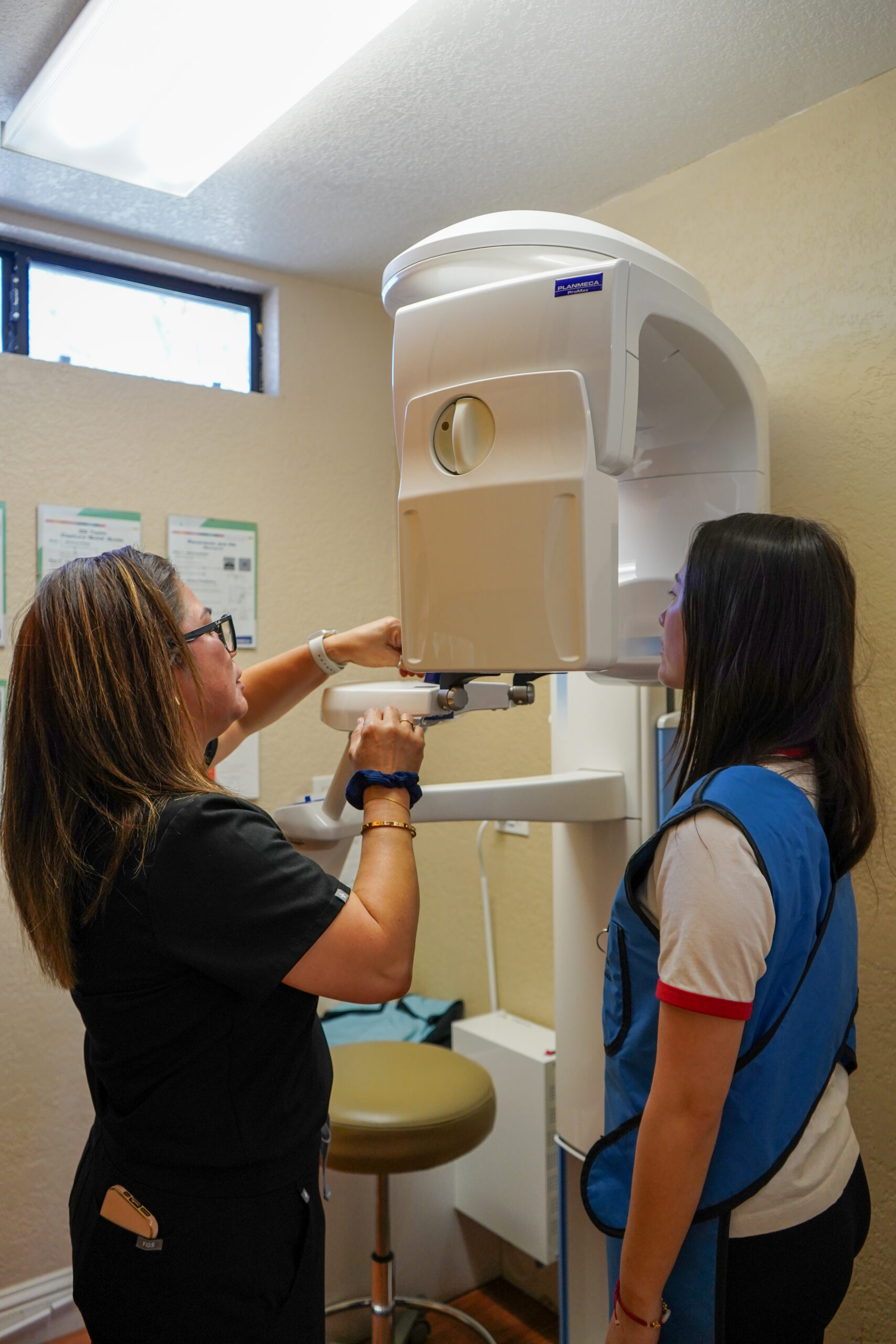
So what’s on the checklist? Here’s what we look at during a normal oral exam and cleaning visit for patients here in Tracy.
- Your teeth, for early cavities, cracks, and worn spots from grinding
- Gum health, including pocket depth and any bleeding when we measure
- Old fillings and crowns, to see if any edges are wearing down or leaking
- An oral cancer screening of your tongue, cheeks, lips, and the floor of your mouth
- How your jaw opens and closes, since clicking or soreness can point to TMD/TMJ trouble
- Your bite, and how your top and bottom teeth meet when you chew
That’s a lot for a short visit. But it moves fast once you’re in the chair.
Some things just can’t be seen with the eye. A small cavity can hide between two teeth. An infection can sit under the gumline for months. That’s where digital dental X-rays come in. They use far less radiation than old film X-rays, and the images pop up on a screen in seconds. You can see them too. We like to turn the screen so you can follow along.
For more complex cases, 3D dental imaging gives an even fuller view. It shows bone, nerves, and roots from every angle. Not every visit needs it. Your dentist will tell you if it makes sense for you.
We see this all the time. A patient comes in feeling totally fine, nothing hurts, no worries at all. Then the X-ray shows a small cavity tucked behind a back molar. Caught that early, it’s a simple dental filling. Left alone for another year or two, it could have reached the nerve. And that’s a very different appointment.
No pain doesn’t mean no problem.
The gum check matters just as much as the teeth. Healthy gums don’t bleed when they’re gently measured. If they do, it’s often the first sign of gum disease. Most people have no idea it’s starting. The good news? Early gum issues often turn around with a solid cleaning and better brushing habits at home.
The oral cancer screening is quick and painless. Your dentist feels along your jaw and neck and looks closely at the soft tissue in your mouth. It takes about a minute., it’s one of the most important minutes of the whole visit.
Kids get their own version of all this. A pediatric oral examination checks how new teeth are coming in and spots early decay. It also helps little ones feel calm in the chair. Our team speaks more than one language, so parents and grandparents can ask questions in the language they’re most comfortable with. Families from all over Tracy bring three generations to us on the same day, and we love it.
At the end, your dentist walks you through what they found. Good news, small watch spots, or anything that needs care soon. You’ll leave knowing exactly where your smile stands. No guessing.
Educational
How an Exam Finding Turns Into a Treatment Decision
So your exam turned up something. Maybe it’s a dark spot on a digital dental X-ray. Or a gum pocket that’s a little deeper than last time. It’s normal to feel a quick jolt of worry right then.
But a finding isn’t a verdict.
It’s the start of a conversation. We walk families in Tracy through this every week. And the path from “we found something” to “here’s the plan” is pretty simple once you see it laid out.
- We confirm what we see. Your dentist checks the spot by eye and with digital dental X-rays. Sometimes 3D dental imaging gives a clearer look at roots and bone.
- We show you the picture. You’ll see the same image we see, right on the screen. No guessing.
- We sort it by urgency. Some things need care soon. Others can simply be watched.
- Next come your options. Most findings have more than one path. We’ll explain each one in plain words.
- You decide. We answer every question first. Then you pick what feels right for you and your family.
That last step matters most. It’s your mouth, it’s your call.
How do we decide what’s urgent? Mostly it comes down to depth. A small cavity in the outer enamel might just need a dental filling. If decay has reached the nerve, root canal therapy may be the best way to save the tooth. A cracked tooth holding a big old filling often does better with a dental crown.
Gums follow the same logic. Light buildup gets handled during a regular dental cleaning. But deeper pockets with tartar below the gumline usually call for scaling and root planing. Same goal either way. Stop the problem before it grows.
Here’s a kind of visit we see all the time. A dad from Tracy came in for a routine cleaning. He had zero pain. His X-rays showed a cavity hiding between two back teeth. You can’t spot that kind in a mirror. We caught it early, it took one short visit for a dental filling. Had he waited until it ached, the story could’ve looked very different –
Most people don’t realize this until it’s too late. Early cavities rarely hurt. That’s exactly why the exam finds them first.
Not every finding needs treatment today. Some small spots are worth watching. We’ll note them in your chart and compare them at your next visit. If nothing changes, nothing needs to happen.
And you’ll never be rushed. Want time to think? Take it. Talk it over at home with your family. We’ll happily explain things again, as many times as you need. If English isn’t your first language, just let us know. We’ll make sure you understand every option before you choose.
Kids get the same care, just with gentler words. We show them the pictures too. A little curiosity goes a long way in calming nerves.
Cleaning vs. Periodontal Maintenance: Why They're Not the Same
This is the mix-up we hear about most. A patient sees “periodontal maintenance” on their visit notes. They figure it’s just a fancy name for a dental cleaning.
It isn’t.
A regular dental cleaning is for healthy gums. It’s preventive. Your hygienist removes plaque and tartar above the gumline and just a little below it. Then we polish your teeth, floss, and check for anything new. Most healthy kids and adults come in for a dental cleaning about twice a year.
Periodontal maintenance is a different visit with a different job. It’s for people who’ve already had gum disease treated, usually with scaling and root planing. Gum disease can make gums pull away from the teeth. Even after treatment, small pockets can stay behind. And those pockets trap bacteria your toothbrush can’t reach.
So periodontal maintenance goes deeper. We clean down into those pockets and measure each one. We also watch closely for any change since your last visit. It’s less about a shiny smile. It’s more about keeping gum disease from coming back.
Here’s how the two visits usually compare. These are general patterns. Your own plan depends on what we find in your mouth.
- Who it’s for: a dental cleaning suits healthy gums, while periodontal maintenance follows gum disease treatment.
- How deep we go: a dental cleaning stays near the gumline. Maintenance reaches into deeper pockets.
- How often you’ll visit: twice a year is typical for a dental cleaning, and periodontal maintenance is often every 3 to 4 months.
- What we track: pocket depths get measured carefully at every maintenance visit.
- The big goal: one stops problems before they start, and the other keeps an old problem under control.
That last point matters most.
We see this happen all the time. A Tracy dad came to us last spring a little confused. He’d finished scaling and root planing a year earlier, felt great, and went back to a dental cleaning every six months. By his next visit, two pockets had gotten deeper. Nothing hurt. That’s the tricky part about gum disease, it stays quiet until it doesn’t.
He didn’t do anything wrong. Nobody had explained why the extra visits mattered. Now he comes in every few months, and his gums have stayed steady.
Can you ever go back to a regular dental cleaning? Sometimes, yes. If your pockets stay shallow and stable for a good while, we’ll talk about it together. But we won’t switch you just to skip a visit., we’d rather see you a little more often than watch you lose a tooth –
If you’ve ever felt unsure about which visit you’re getting, you’re not alone. Families all over Tracy ask us this every week. We’ll always explain your plan in plain words. We’ll also do our best to use the language you’re most comfortable with. You should never leave our office wondering what we did or why.
FAQ
Common Questions
How do I know if I need a dental filling or something more, like a root canal?
It depends on how deep the decay goes. A small cavity sitting in the outer enamel usually just needs a dental filling. But if decay has reached the nerve, root canal therapy becomes the better way to save the tooth. Your dentist checks this with digital dental X-rays during your exam in Tracy. That’s why routine visits matter so much, catching a problem early often means a simpler, shorter fix.
What is the 2-2-2 rule for teeth?
The 2-2-2 rule is a simple way to remember home care. Brush twice a day for two minutes each time, and see your dentist every two times a year, which means every six months. This habit helps catch small issues, like early cavities or gum changes, before they turn into bigger problems. A routine dental exam checks your teeth, gums, and bite, so sticking to this schedule gives your dentist the best chance to spot trouble early.

How painful is a tooth extraction, really?
Most patients feel pressure rather than sharp pain during the procedure itself, since the area is numbed first. Any soreness afterward is usually mild and manageable with care at home. Pain levels vary by person and by how complex the extraction is. If you’re worried about an upcoming extraction, talk with your dentist about what to expect for your specific tooth and situation.
Can gum disease really turn around, or is it permanent once it starts?
Early gum disease often turns around with a solid cleaning and better brushing habits at home. Your dentist checks gum health by measuring pocket depth and watching for bleeding during your exam. Most people don’t know gum trouble is starting, since it rarely hurts at first. That’s why the gum check matters just as much as checking your teeth, and why catching it early makes such a big difference.
Does living in Tracy affect how often I should get dental exams?
Tracy families often bring multiple generations in for care on the same visit, so dentists here are used to serving a wide range of ages and needs. Regular routine exams still follow the same six-month schedule for most patients, no matter where you live. What matters more locally is finding a dentist families trust for clear answers in a language they understand. Our page on what a routine dental exam covers walks through exactly what happens at each visit.
What's the difference between a regular cleaning and periodontal maintenance?
A regular cleaning handles light buildup above the gumline during a standard dental cleaning visit. Periodontal maintenance is for deeper gum pockets with tartar below the gumline, which usually need scaling and root planing instead. Your dentist decides which one fits based on pocket depth measured during your exam. Both aim to stop gum problems from getting worse, just at different stages.
Visit Us Today
Schedule an Appointment for Dental Implants
Maintain the stability and appearance of your newly aligned smile. Contact Smiles Dental Spa to schedule an appointment for dental retainers and space maintainers with Dr. Shirley Zhao.
Contact our office at (209) 836-1748 or conveniently schedule your appointment online through NexHealth. Visit us at 1431 N Tracy Blvd, Tracy, CA 95376—trusted care tailored for your family.

Phone

Location
1431 N Tracy Blvd
Tracy, CA 95376